

Why is it so hard to say what we really feel?
Most of us have feelings, needs, thoughts and desires that we find difficult to express. Too often we stay quiet when we want to speak, say “yes” when we mean “no”, or hide parts of ourselves that feel too risky to reveal. In this first article of a three-part series, I explore why that happens, how these patterns often begin as forms of protection, and what they might be trying to protect us from.
The cost of keeping parts of ourselves hidden
Most of us know what it's like to leave a conversation thinking, "I wish I'd said what I was actually feeling." Maybe you agreed when you wanted to disagree, or laughed something off when it hurt. Maybe you said "I'm fine" when you weren't, or perhaps you carefully chose words that felt safe, while the thing you most wanted to say remained firmly in the background.
From the outside, it can seem strange. Why don’t we just say it? The answer, I think, is that being honest is rarely as simple as it sounds. Because what often stops us isn't a lack of words – it's fear.
We learn early what is acceptable
Most of us learn something – consciously or unconsciously – about which parts of ourselves are acceptable. Perhaps that anger leads to conflict. Perhaps sadness makes other people uncomfortable. Perhaps excitement is "too much". Perhaps asking for help isn’t encouraged. Perhaps vulnerability dosn’t feel safe.
These lessons are rarely taught directly. More often they're absorbed through experience – through countless interactions in which we discover what brings connection and what seems to threaten it. And because connection matters – especially when we're young –, we adapt. We find ways to stay close to the people around us.
The trouble is that adaptation often involves hiding parts of ourselves. Not because they're bad – but because they once felt risky.
The parts that learned to stay quiet
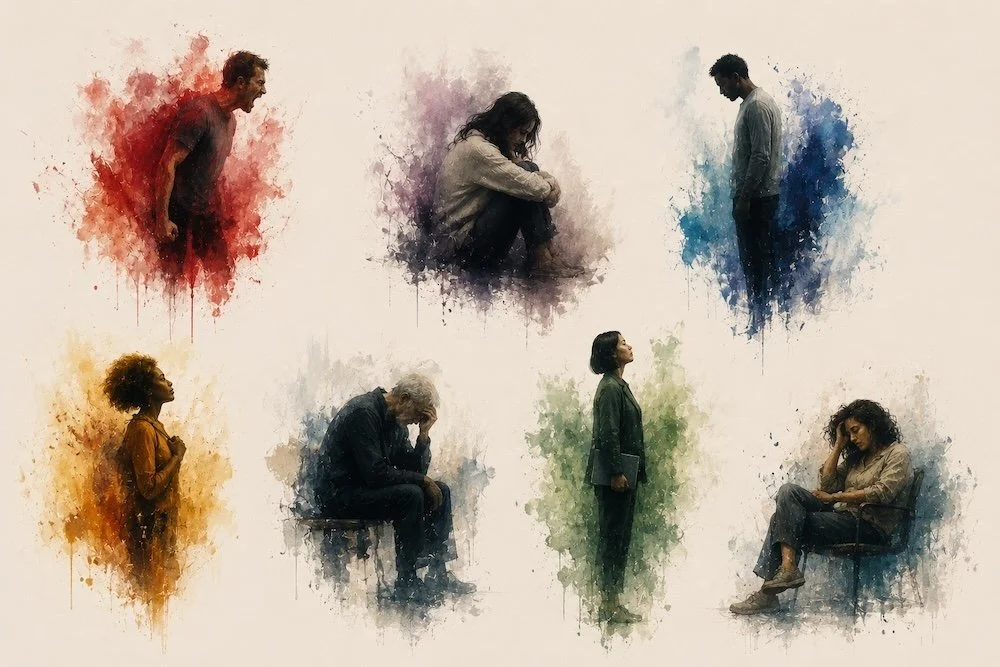
One of the things I often notice in therapy is that people aren't simply holding back feelings – instead, they're holding back parts of themselves: the angry part, the needy part, the frightened part, the ambitious part, the grieving part, the exhausted part. The part that wants more; the part that wants less. The part that wants to say, "Actually, this isn't working for me."
These parts don't disappear when they're pushed aside. Instead, they tend to linger in the background, looking for other ways to be heard. Sometimes they emerge as anxiety, sometimes as resentment. Sometimes as a vague sense of disconnection, sometimes as the feeling that nobody really knows us.
What once protected us can begin to limit us
The important thing is that these patterns usually make sense. The person who avoids conflict may have learned that conflict was dangerous. The person who never asks for help may have learned that needs were unwelcome. The person who keeps everyone happy may once have depended on doing exactly that.
These strategies are often intelligent responses to the situations we found ourselves in. The difficulty comes later. Because what protects us in one chapter of life can restrict us in another. What once kept us safe can leave us feeling unseen and unfulfilled.
The loneliness of not being known
This is where the cost often becomes apparent – because relationships can only respond to the parts of us we bring into the room. If I never tell you I'm hurt, you never get the opportunity to understand me. If I never tell you what I need, you never get the opportunity to respond. If I never show you who I am, you can only relate to the version of me that feels safest to reveal. And after a while, that can become lonely. Not because nobody cares but because nobody really knows what's happening underneath.
Honesty starts with ourselves
When people hear the phrase "say what you feel", they sometimes imagine complete emotional transparency – such as ‘telling everyone everything’. But that isn't what I'm talking about. Often the first step isn't saying something difficult to another person – it's admitting something difficult to ourselves:
"Actually, I'm angry." "Actually, I'm hurt." "Actually, I'm scared." "Actually, I want something different."
That kind of honesty can be surprisingly challenging; yet it is often where change begins.
Therapy as a place to practise
One of the reasons therapy can feel powerful is that it offers a space to experiment with bringing more of yourself into the room. Not the polished version or or the version that has everything figured out… I’m talking about the secret, hidden version: that's confused, ashamed, hopeful, frightened, grieving, angry or uncertain. The parts that may not have felt particularly welcome elsewhere.
When those parts are met with curiosity rather than judgement, something begins to shift. You can learn that you don't have to fight so hard to keep them hidden. And sometimes, that creates the possibility of a different question: Not "Why am I like this?" But "What might happen if I allowed a little more of myself to be seen?"
Coming next: why change feels so risky
Recognising a pattern is one thing. Changing it is something else entirely.
Many of us know what we should do. We should be more honest. We should ask for what we need. We should set boundaries. We should stop people-pleasing.
But knowing and doing are very different things. Because change asks something difficult of us: it asks us to take a risk.
In the next article in this series, I’ll explore why change can feel so frightening, why vulnerability is often at the heart of growth, and how taking small relational risks can open the door to new ways of being.
Until then…
If something here resonates and if you’d like support in your life, please get in touch to arrange a free 20-minute introductory call.